The MGA With An Attitude
FRONT SUSPENSION REBUILD -- FS-202
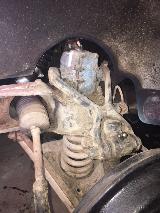
This procedure will refer to some details on other pages. Start by loosening wheel bolts (steel wheels), lift chassis and set frame on jack stands, loosen knockoff (wire wheels), remove wheel(s).
Raise front of car, place frame on jack stands, remove road wheels
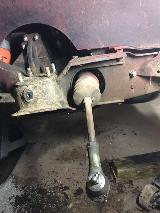
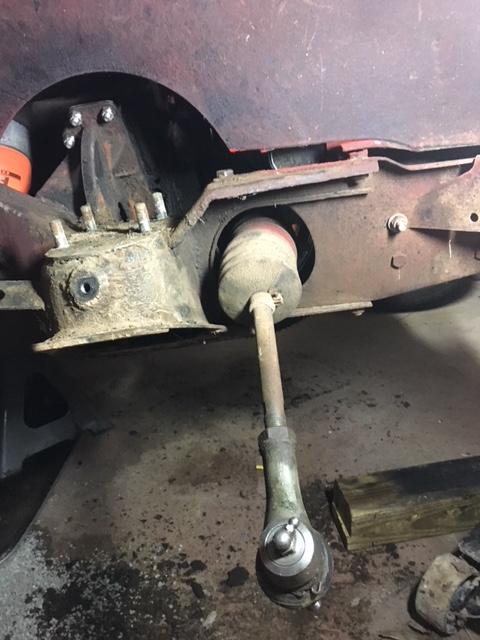
Disconnect tie rod end ball joint (or unbolt steering arm on MGB)
Disconnect brake hose and lower pipe (drum brakes) or dismount caliper (disk brakes)
Remove brake drum (drum brakes)
Disassemble brake shoes if desired (drum brakes)
Remove bearing spindle nut and remove bearing hub (including brake disc)
Remove brake backing plate (drum brakes) or dust shield if fitted (disc brakes)
Disconnect anti-swaybar link (if fitted)
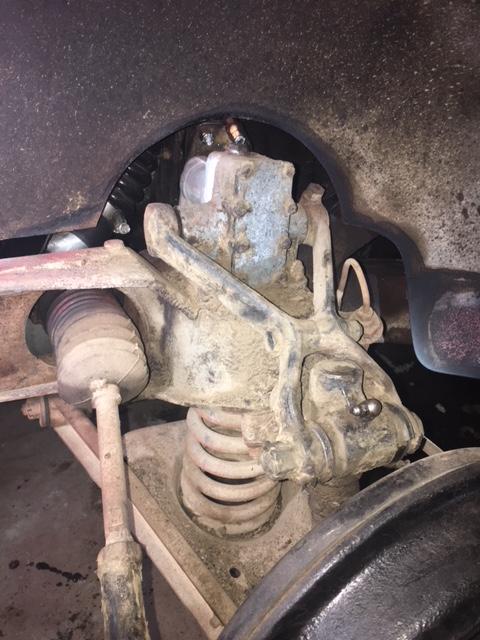
Jack under A-arm and remove top trunnion bolt
At this point you can remove the shock absorber if needed. If all you were after was to replace the shock absorber, you can skip most of the steps above, just jack up the A-arm and remove the shock. If you are disassembling everything, then it is easier to do the steps above while the shock arm is still connected.
Remove bottom trunnion bolt to dismount swivel pin assembly (or MGB kingpin)
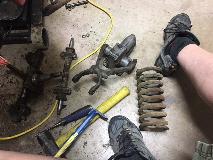
Lower jack and remove the coil spring - (See details)
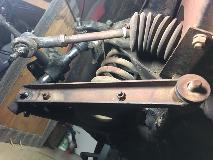
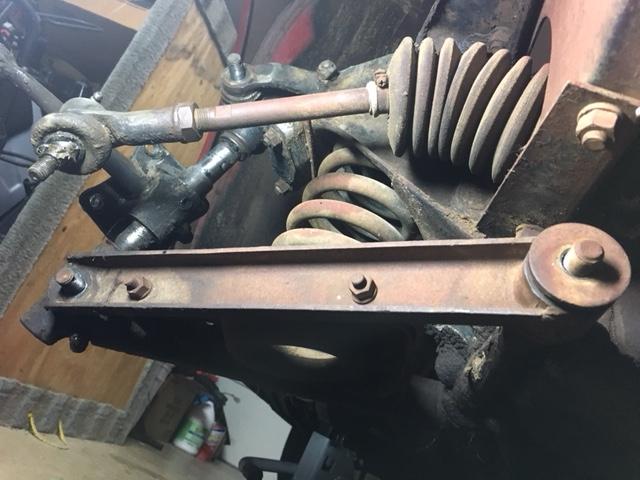
Disassemble lower A-arm brackets (at least one)
Remove A-arm parts from inner pivot shaft
Remove inboard Pivot from frame (if desired)
Check condition of the rubber rebound buffer and its spacer block
Check condition of frame flange holding the rebound buffer.
Sometimes the frame flange may be bent up or cracked in this location due to some prior heavy impact of the tire on a curb or large pot hole. If so, then this is the time for straightening and/or welding repair if necessary.
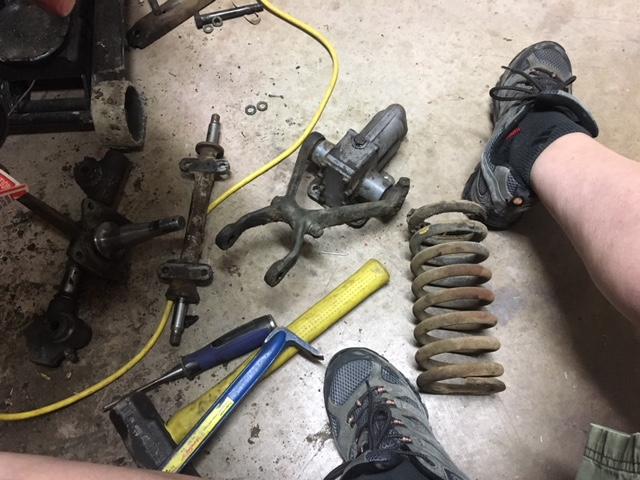
Disassemble swivel pin assembly
Check to see if swivel pin is straight
Straighten swivel pin (or replace) if necessary (very unlikely)
To disassemble swivel pin assembly, first remove steel bearing tubes from the swivel links, and then unscrew swivel links from the swivel pin. If the steel tube is not removed the links will not come off, or it my bind severely and damage edge of threads from interference of steel tube. Do not disassemble the MGA steering arm and swivel pin from the knuckle unless one of these parts must be replaced. A swivel pin may sometimes be bent from a heavy impact on a tire. If so, then replace it or straighten it before going on.
Clean everything
Consider checking Swivel Pin and A-arm Pivot for cracks
Check condition of A-arm Pivot shaft ends.
Check condition of A-arm holes for oval wear.
Check condition of trunnion bolts for wear.
Rubber bushings for A-arm inner Pivot ride and rotate on the Pivot shaft with suspension motion. If the Pivot shaft is rusted and badly pitted it should be replaced (as a pitted shaft can tear up rubber bushings). A possible alternative to replacing a pitted Pivot could be to install MGB GT V8 type A-arm bushings. These bushings have a steel tube inner liner similar to silentblok bushings in a leaf spring. When installed the steel tube is pinched at the ends and does not rotate on the shaft.
A-arm brackets often have outer end holes worn oval from the trunnion bolt rotating in the arm when a trunnion bushing has been seized. These holes can be welded and redrilled, but the parts may be readily available and cheap enough to replace. Any necking down of the trunnion bolts dictates replacement.
Check fit of threads between swivel links and swivel pins.
Replace any parts that are obviously worn.
Swivel pin threads should be clean and smooth, and the swivel link should be snug on threads of swivel pin. When new and greased there is no perceptible wiggle in these parts. If the swivel pin threads are rusted and rough it should be replaced. If the swivel link threads are worn to be a sloppy fit it should be replaced. The Workshop Manual states, "An appreciable amount of slack is permissible in these threaded bearings and they do not require renewal unless they are very slack". This is a judgment call, as the pieces will not actually fall apart unless the threads are worn enough to be completely stripped. However, excess slop in these threads may contribute to front end shimmy if a wheel is slightly out of balance or not perfectly straight running.
Bottom end of the swivel pin is more likely to be rusty due to water intrusion. Bottom swivel link is more likely to be worm because it carries the weight of the car. Top swivel link threads may last twice as long in service as the lower ones. My top swivel link threads are in good condition after 370,00 miles, while the lower links were changed once around a quarter million miles. Grease is your friend here.
Replace bushings in swivel links if necessary
Ream bushings in swivel links if replaced
Replace steel bearing tubes if rusted or worn
Replace swivel link thrust washers or seal carriers if damaged
Running clearance between swivel link bushing and the smooth steel bearing tube is nominally 0.002-inch on diameter, similar to a rocker arm bushing or crankshaft bearings (0.001" radial clearance for grease). Measure parts carefully. Bushing bore should be exactly 3/4-inch (0.0750"). Bearing tube outside diameter should be slightly smaller (0.748") and very smooth. If the steel tube is rusted, worn or pitted it should be replaced. In assembly with grease there should be no wiggle between the bushing and steel tube. A small amount of wiggle may not be particularly detrimental to normal function, but excessive slop can contribute to front end shimmy if a wheel may be slightly out of balance or not running perfectly straight.
Bushing in swivel link can be removed by cutting through one side of the bushing from the inside with a hacksaw, then easily pushing the bushing out of the swivel link. It may also be removed with a press if you have a properly sized driver punch. A new bushing can be installed by pressing into place with a large bench vice (or a press with a piloted punch). Do be careful to get the bushing started straight, and try not to raise much of a burr on the end when pressing it in. Hammering on the end of the new bushing is definitely a no-no, but you could hammer one in of you use a properly sized piloted punch (and be careful to keep it aligned). The hole in the side of the bushing must be aligned facing the swivel pin. The bushing must be entirely flush with the swivel link shell at both ends, not protruding at the ends. New bushings must be reamed to finished size after installation.
When bushings and steel bearing tubes are ready for reassembly, carefully measure the lateral length of the swivel link and the tube. The tube needs to be 0.008" to 0.013" longer than the swivel link shell, so the thrust washers will not bind at the ends in assembly. You can determine this with careful measurement, or place it in assembly and check end clearance with a thickness gauge, or check end float in assembly with a dial indicator. If all parts are correct size, changes of length should not be necessary. If the tube may be too long it could be ground down a bit, but it must be kept perpendicular across the ends. If the tube may be slightly too short the swivel link shell could be ground down a bit, but it also must be kept perpendicular across the ends. Do not reduce length of the swivel link shell too much, as it has to mate with the upper and lower suspension arms.
Reassemble everything (chuckle)
Assemble rebound buffer and spacer block
Install shock absorber on frame
A-arm Pivot and brackets, spring pan and coil spring
Reassembly is reverse of disassembly, with a little more fiddling. Start by installing the shock absorber and the rebound buffer and spacer block below the shock arm.
Install rubber bushings at inner ends of the A-arm brackets. Original type rubber bushings or urethane bushings can be pushed into place by hand. Urethane bushings may call for some lubricant for the inner bore to shaft joint (or maybe not). Some people say these parts might squeak in operation, but I have not found that to be so even when running dry. Urethane bushings might last indefinitely without wearing out, where standard rubber bushings might need replacing as often as every two years if you drive a lot. Urethane may give slightly more "feedback" from road bumps, but I happen to like the slightly firmer feel of the suspension. The MGB GT V8 style bushings can be wet with soapy water and pushed into place using the bench vice, after which they should stay secure and never move. They may also last a long time without wearing out, because they twist the rubber a bit in operation rather than turning on either ID or OD.
Assemble the Pivot and A-arm brackets and spring pan on the chassis. Tighten the Pivot to frame bolts, but leave the end nuts and A-arm bracket bolts loose until later. For the MGB GT V8 type bushings it is a good idea to put anti-seize compound on the Pivot to make later removal of the steel lined bushings easier. Insert the coil spring and jack up the spring pan. Loosen the pinch bolt located half way out on the shock absorber lever arm so you may be able to spread the arms slightly when installing the upper trunnion.
Assemble and install swivel pin assembly
Swivel pins and swivel links have left hand threads for left side parts and right hand threads for right side parts. Top swivel links have the bump stops. Steering arms point forward and swivel pins tilt inward at top. Be sure the threads run free for full length of engagement. Grease threads a bit before assembly. Install swivel pin seal on the swivel link and screw it fully onto the swivel pin. Back off the thread a few turns until the bushing bore aligns with necked down area on the swivel pin. Insert the steel bearing tube into the bushing. Rotate the swivel link right and left as much as two turns each direction to determine where the steel tube will (gently) interfere with the thread on the swivel pin. Count the turns between maximum and minimum engagement where it binds. Turn the swivel link to be half way between these points. Then turn the swivel up to one half turn maximum (closest direction) to align it for assembly to the mating suspension arm.
The trunnion seal support has a flanged cup shape. The flat side goes toward the nut or bolt head while the flanged side goes toward the swivel link. Put the trunnion seal on the support, put the hardened steel thrust washer inside the seal and support, and install the lip of the seal over the end of the swivel link. A small orbital motion can help to make the seal lip jump into position on the swivel link. Repeat for two seals on each swivel link.
Install the swivel pin assembly onto the suspension arms. Start with the lower trunnion first in case the A-arm brackets may not be in correct alignment. Position the lower trunnion (with washers and seals) between the A-arm brackets. Run an alignment punch or small rod through the holes to align the thrust washers and seal supports with the rest of the bores, and install the lower trunnion bolt. Pull the swivel link assembly into alignment with the shock absorber arm (if A-arm brackets were not yet aligned). Spread the shock arm sides a bit if necessary, and insert the upper trunnion (with washers and seals) into the shock arm. Raise or lower the shock arm as needed, and/or raise the floor jack if necessary, aligning all of the bores with an alignment punch or small rod before installing the top trunnion bolt.
With all bolts still loose, swing the knuckle through a wide sweep, up to 180 degrees, while watching the swivel pin and swivel links. If the swivel pin is straight the swivel links will remain stationary and the swivel pin will appear to stand still as it rotates. If the swivel pin is bent one or both of the swivel links will do a little rocking motion as the knuckle swings around, which is not acceptable. A bent swivel pin could make the trunnions and mounting bolts wobble in operation causing the bolts to work loose and parts to wear when they should not. Do not settle for less than a perfectly straight swivel pin.
Connect the anti-swaybar link (if fitted)
Tighten all bolts
Connect the tie rod end ball joint
Install Brake backing plate (drum brakes) or dust shield if fitted (disc brakes)
Reassemble wheel bearings and brake parts
Install road wheels and set car on ground
Settle front suspension and tighten inner A-arm pivot nuts
Check/adjust front end alignment
When you are sure the swivel pin is straight and everything is in place you can connect the anti-swaybar link and tighten all of the bolts. If you use the MGB GT V8 bushings, then leave the nuts on the ends of the A-arm Pivot loose until later. Connect the steering tie rod ends securely. Install brake backing plates or dust shield as fitted. Install hubs with wheel bearings and seals and grease covers. Assemble brake parts, rotors, calipers, drums etc. Connect hydraulic pipes and hoses, and adjust and bleed the brakes. Install road wheels, remove jack stands and lower the car to ground.
Bounce the car a little to settle the suspension to normal ride height before tightening the nuts on the A-arm inner pivots. This step is to centralize the BV8 type bushings on the A-arm pivot so they will encounter equal twist with both up and down travel of suspension, not over stressing the rubber. Check and/or adjust front end alignment as necessary. A test drive is a good idea to be sure it all works right before you drive too far.
|