The MGA With An Attitude
Gunson "Clik-Adjust" -- TS-080
(and why you don't need it)
You can download the original Gunson Click-Adjust instructions (186-KB pdf file).
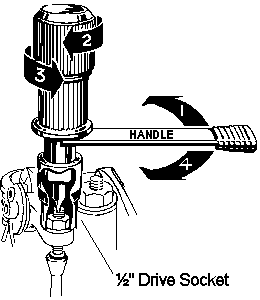 Considering how much recommendation this tool gets, I wonder why no one ever mentions the pitfalls, drawbacks and error level that you may encounter.
One of the major selling point for the Clik-Adjust tool is that is can compensate for measuring error caused by a worn rocker arm tip. This is why the instructions call for using two feeler gauges to calibrate the tool. If the output end of the rocker arm is badly worn to the point of being seriously concave at the point of contact with the valve stem, it would indeed be hard to measure the gap correctly with a feeler gauge. My personal view on that point is that if the rocker arm is that badly worn it should be repaired or replaced, and it is not particularly difficult to dress the output surface of the rocker arm to clean it up. On a one-off basis it may even be cheaper to clean up the rocker arms than to buy the Clik-Adjust tool (especially if you do it yourself and don't pay the labor charge). But for someone who makes a daily routine of adjusting valves on lots of old worn engines (and getting paid for it) it may well be cost prohibitive to repair all of the worn rocker arms that come through the shop, and this tool might then serve a very useful purpose. "Get this junker running and out of my shop, because the customer won't pay for a proper repair".
The MGA (or MGB) rocker arm has a mechanical ratio of 1.42:1 with the valve end being longer and moving farther than the pushrod end. This means that the intended .015" gap at the output end represents only .0106" motion at the input end where the adjuster screw is located. The adjuster screw has a 5/16 UNF thread at 24 turns per inch, giving 0.0417 inch advance for one turn of the screw. Simple division yields 0.254 turns of the screw needed to give 0.015 inch clearance at the valve end of the rocker arm. At 30 clicks per turn of the tool this would be 7.62 clicks. If you round that off to exactly 8 clicks you get a final gap a lot closer to 0.016 inch rather than the intended 0.015 inch. If you're really not that particular about this built in .001" round off error in the setting, maybe you should ask yourself why you need this tool in the first place. (Note: Some later production tools may have 40 clicks per turn).
The next problem is that for someone who works on a number of different cars with various valve gear geometry you would have to keep a sizable chart of the various number of clicks required for different engines. If you can't memorize the entire chart, or if you don't have it pinned on the wall nearby, or if you don't carry it when you're traveling, then you need to keep in mind the procedure for calibrating of the tool on the fly. You may need to recalibrate it every time you work on a different engine. In the case of your own car when you don't use the tool very often you might even forget the setting and have to recalibrate it every time you use it anyway.
To avoid having to note or measure thread pitch and rocker ratio and do a number of calculations each time, you can use the feeler gauge method to calibrate the tool. This method requires the use of two different thicknesses of feeler gauges. This is about equivalent to the process of adjusting two valves with a feeler gauge, and it is also subject to the same requirements of finesse of touch (a learned skill) and the resulting possibility of error from the two successive settings. But it is a universal procedure which does not require any calculations.
Success in using the Clik-Adjust tool depends on having a free running thread on the adjuster screw, and in the rocker arm, and in the jam nut. It is fairly common on these older engines for some DPM to have overtightened the jam nut resulting in a stretched thread which may bind considerably when you are trying to adjust it. So unless you are intimately familiar with each and every engine being worked on, and are certain that the adjuster screws do not bind, you would need to take the time to run each adjuster screw in and out a few turns to be sure they are not binding, and if any screw does bind in the thread it must be repaired before using the Clik-Adjust, all of which increases the time required to do the valve adjustment.
You may soon determine that this new tool may not be a time saver at all. In fact it may well take longer just to learn to use this tool than it does to adjust the valves in the traditional manner with a feeler gauge. Also consider that the Clik-Adjust is a single purpose specialty tool, where the feeler gauge set is a more universal tool good for a lot of other uses. I tend to shy away from such specialty tools as they cost a lot of money and tend to fill up garage space as they accumulate. As this tool is somewhat larger than a feeler gauge (and also redundant), I would never carry it in my traveling tool kit. I do occasionally feel the need to do a valve adjustment on the road or at a friends house, and I also do an occasional road trip that is long enough to merit a valve adjustment in the middle of the trip. So for perhaps as many as half of the valve adjustments that I do this tool would not be available even if I did own it.
Bottom line is, I can think of other things I'd rather do with the money, but if you insist on living with badly worn rocker arms, maybe you could use one of these things.
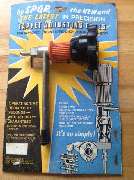
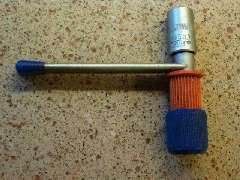
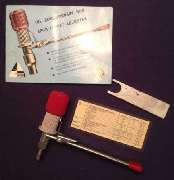
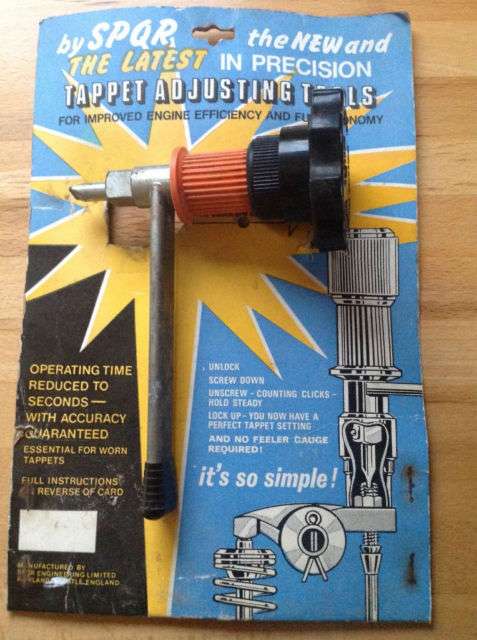
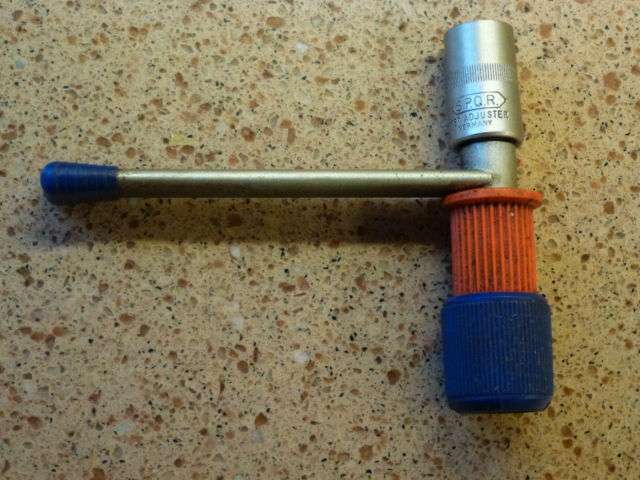
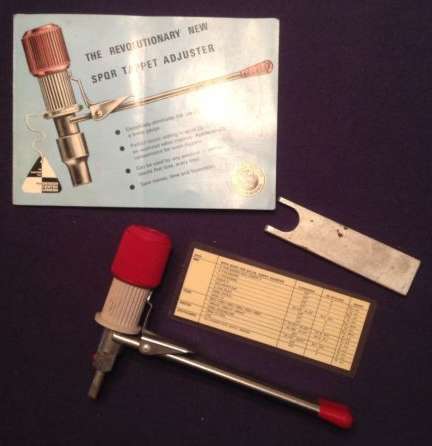
Before Gunson Click-Adjust there was SPQR from Germany.
and later by Standard-Triumph Motor Co. Ltd.
You might also like to read CH-106 for Valve Adjustment Without a Feeler Gauge.
|