The MGA With An Attitude
VACUUM LINE ROUTING - IG-121
Common question: How do you install the vacuum line from carburetor to distributor?
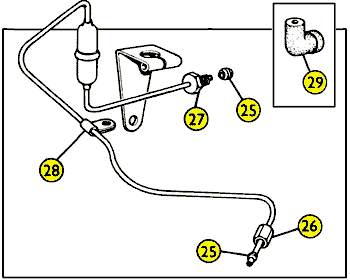
When you buy a "pre-bent" vacuum line for MGA (or early MGB) it may look something like this illustration. This does not show all of the bends, correct orientation of the end fittings, where it follows around the engine, or where it connects at the ends. There should also be a small bolt and nut running horizontally through the bracket to pinch onto the bulb. Item 29 is an optional rubber connector used for the later MGB style vacuum advance unit with push-on connector.
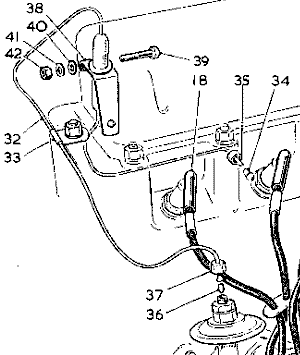
The metal pipe should be all one piece from carburetor to distributor with a fuel separator bulb in the middle. The bulb is filled with wire wool with the metal pipe on each end to serve as a fuel separator. The bulb goes upright with bottom end connected to carb and top end connected to dizzy. The bracket holding the bulb was originally mounted on the second manifold bolt from back. However, with engine in the car you may find it easier to install the bracket on the rear manifold bolt. The P-clip goes on the rear head stud. Use a second nut there if the stud is long enough. Otherwise you have to R&R the nut to install the P-clip.
Illus#   Part#   Description
	AUC4490  Union, automatic ignition, rear carburetor
32	 1H830   Pipe, vacuum ignition control (with fuel trap)
32	 1H919   Pipe (new part number)		Com. (E) GB11301
34	 2K6192  Nipple, carburetor end		Fin. (E) GB11300
35	 2K6193  Tube nut, carburetor end	Fin. (E) GB11300
35	 2A459   Tube nut (new part number)	Com. (E) GB11301
36	 6K649	 Olive - Qty 1/2 - (qty increased at (E) GB11301
37	 6K650   Tube nut, distributor end
 Item 34 in the illustration above was originally a long brass nipple soldered to the pipe, using a female threaded flare nut. Details of that pipe end and the required adapter fitting can be found in tech article CB-125 in the Carburetor section.
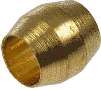 After 11,200 engines (October 1956) the soldered fitting was changed to the small brass olive, and a matching male threaded compression nut.
The current Moss Motors replacement pipe has a male threaded nut and brass olive (items 27 & 25 at top of page).
These fittings are not interchangeable, because the female threads in the throttle body are different.
To use the Moss Motors pipe with the early style adapter fitting you can remove the end fitting from the Moss pipe and install the original female threaded compression nut and soldered flare fitting.
|
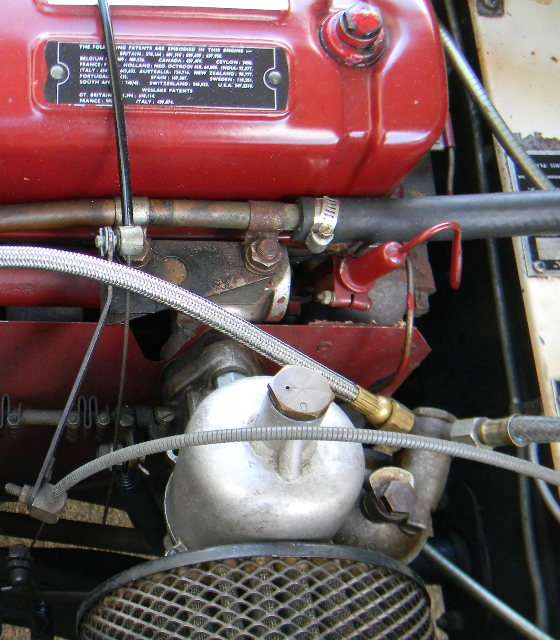
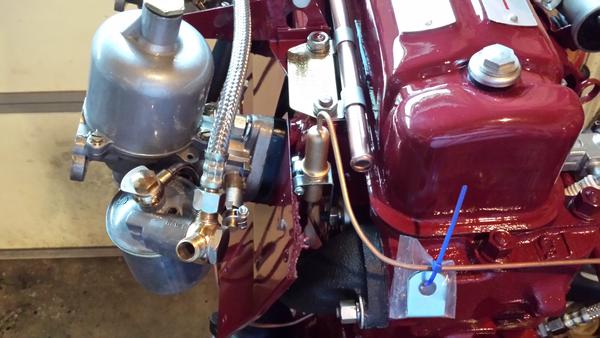
Photo at right below shows the fuel separator bulb and bracket correctly on the second stud from the back. However, the lower tube is incorrectly turned back upward to run over the top of the heat shield before going underneath the carb. This was claimed to be an original MGA 1600 survivor car with low mileage, but it appears to have been "tampered" with in various ways. The valve cover was repainted (poor masking job on the patent plate), the firing order plate is missing (proof of prior disassembly), heater hose changed with incorrect hose clamp, apparently incorrect vented dashpot cap on the carburetor (not the later dustless carbs), and the vacuum pipe is painted (I think not originally painted). Subsequently I think routing of the vacuum pipe to the carburetor is incorrect.
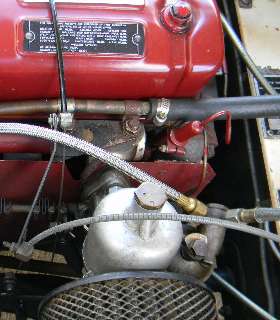 The pipe from bulb to carb originally ran down the inboard side of the the heat shield to pass underneath, then back up the outboard side to connect to the under side of the rear carburetor. If you put the bracket on the rear manifold bolt (not original) you may find it easier to run the pipe around back of heat shield, then under the carb.
The vacuum port (internally) is on bottom of carb, left of center, underneath the edge of the throttle plate. The external threaded port is to the left of center underneath, (toward front of car) opposite the float chamber. If you haven't installed the carbs yet it may be prudent to connect the vac line to the rear carb before installing the carbs on the engine.
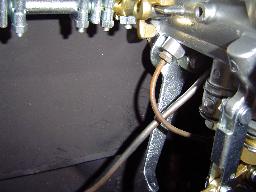
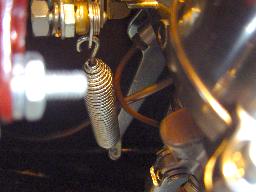
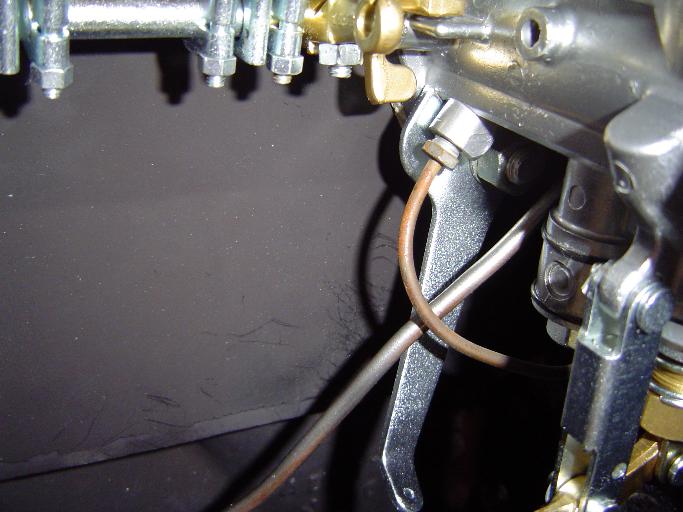
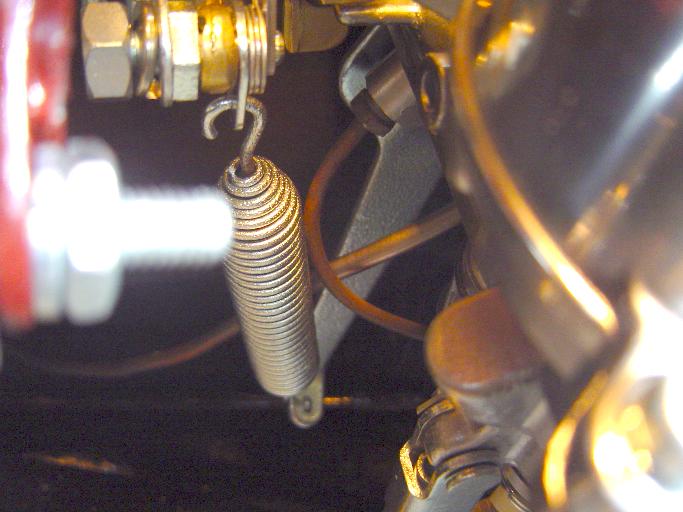
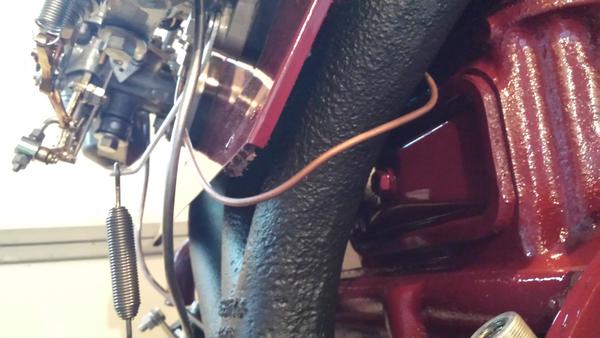
Two pipes in the picture above left are the vacuum line and fuel vent/overflow pipe. These would be better off running behind the spring bracket (like picture above right) leaving better access for wrenching on the lower carb mounting nut. Photo at left shows the later style male threaded nut when the adapter fitting was deleted (most MGA are like this). Photo at right shows the early style connector adapter with soldered end fitting and female threaded flare nut. You may have difficulty finding the early style vacuum pipe as a modern replacement part. The fittings are not interchangeable, because threads in the throttle body are different.
The distributor end of the pipe originally has a female threaded nut and another compression olive. If the distributor drive gear is installed properly, the vacuum unit will point straight up. The pipe connection nut will be underneath the heater valve, requiring a 90 degree turn in the pipe just above the nut. Life will be easier if you leave 1/4" of straight pipe above the nut. Pipe between the vac unit and P-clip on rear head stud has to flex when you rotate the dizzy for spark timing.
Addendum March 30, 2020:
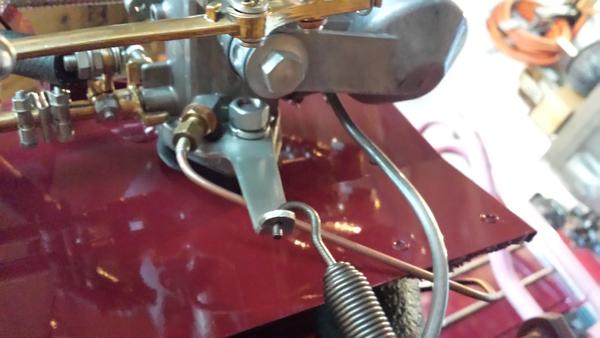
More photos from Ron Bissland in Kenosha, WI, USA
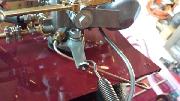
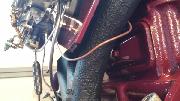
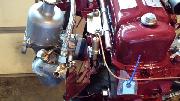
I would not attempt to wrap the vac pipe around the rear exhaust runner as shown here. Run the pipe downward from the fuel separator between the center and rear branches of the exhaust manifold, under the heat shield, and back up to the carburetor vac port. Form the pipe close to the heat shield to stay away from your wrench access.
Addendum November 18, 2026:
People keep asking, so maybe not clear enough yet. I will try again.
You have to be there with your hands in the space allowed to figure it out.
Start with the fuel separator bulb to be secured to the "L" bracket and the thin screw (pinch bolt). The bulb goes into the bracket from top. seating the bulb flange against the bracket, and tightening the pinch bolt. Shorter end of the pipe going to the carburetor is going down. Longer end of the pipe going to the distributor is going up. In short, bottom end of the bulb connects to the carburetor, so any captured fuel running out of the bulb runs down hill back to the carburetor. The bulb must be vertical with the distributor end upward to prevent fuel from getting into the vacuum advance diaphragm.
Original installation had the bulb bracket attached to manifold stud second from the rear. That sort of requires the tube to be properly bent and installed in place with manifolds tight before the heat shield goes on. That is a royal PITA, only done with original factory assembly line, so only for the most enthusiastic concours buff.
in the real world it is much easier to put the bulb bracket on the rear most manifold stud. Then you can R&R the vacuum pipe assembly with the the heat shield and carburetors in place. Still, much easier done with air cleaners removed, and easier still with the front carburetor removed and out of the way.
From bottom of the bulb, run the pipe downward behind the heat shield, around the back edge of the heat shield, then forward under the rear carburetor. Finally turn upward and rearward to terminate with the screw end in line with the vacuum port under the carb.
Do not make the final bend too close to the nut. Good if the pipe end is straight and long enough to push the nut down the pipe about a half inch while still free-wheeling to be turned with your fingers. And the pipe end has to be exactly aligned with the threaded vacuum port if you ever hope to get the thread started.
Push the pipe end with the olive compression fitting into the port first, seating the olive well into the port, then to be followed by the threaded nut, still held exactly in line. While holding the pipe in place, you can then turn the nut to get the thread started, after which the rest is just skinned knuckles. Run up the threaded nut and snug it up to compress the olive making the vacuum tight seal.
One more recommendation. Future life will be easier if you leave enough space around this pipe connection to swing a stubby 9/16" wrench for working the securing hex nut under the rear carburetor. Take a little more time as needed to rearrange the throttle return spring bracket and vacuum pipe connection to accommodate the required wrench.
From top of the bulb, Form a goose neck bend in the pipe to run it down and horizontally cross the back of the cylinder head. The rear head bolt should hold a large P-clip (with small pipe bore) to secure the pipe to the engine (definitely not on the heater shelf). From there run the pipe across the head, then downward and forward under the heater valve. Here the pipe has to make a 90-degree bend downward to line up with the fitting on the vacuum advance unit. Again, similar to other end of the pipe, do not make the final bend too close to the nut. Good if the pipe end is straight and long enough to push the nut back on the pipe about a half inch while still free-wheeling to be turned with your fingers. And the pipe end has to be exactly aligned with the threaded vacuum port if you ever hope to get the thread started.
Push the pipe end with the olive compression fitting into the port first, seating the olive well into the port, then to be followed by the threaded nut, still held exactly in line. While holding the pipe in place, you can then turn the nut to get the thread started, after which the rest is just skinned knuckles. Run up the threaded nut and snug it up to compress the olive making the vacuum tight seal.
All finished, the pipe bent end and compression nut need to pass clear and not interfere with the heater valve or any of the valve fittings. When setting ignition timing, you need to be able to rotate the
distributor without hitting the heater valve.
Another suggestion, coming from experience. It is common for the vacuum pipe to be broken very near to the bottom end of the fuel separator bulb. This may happen about the second time you need to R&R the rear carburetor, or need to R&R the cylinder head, or in short, any time you need to fiddle with the vacuum pipe in the future. Not nice to accidentally destroy the pipe and have to replace it again later.
It is not a bad idea to intentionally cut the vacuum pipe about 1/2-inch below the fuel separator bulb, and re-connect it with a short piece of small bore rubber hose. Then not only do you know where the break is, but it also allows you to remove the short end of the vacuum pipe when working with the rear carburetor, or remove the long end of the pipe when working with the cylinder head.
And along the same line, it could be helpful if the rear head bolt (stud) was replaced with one about 1/2-inch longer. This can allow use of an additional flat washer and hex nut to secure the vacuum line P-clip, so you can R&R the vacuum pipe without loosening the rear head bolt nut. Original short head stud is 3/8"x4-1/2" UNCxUNF. Wondering if I could find 3/8"x5" double threaded stud.
|